China did not stumble into solar dominance. It built it, year by year, with cheap credit, cheap land, cheap power, and a government that treated polysilicon, wafers and modules as strategic assets rather than just another factory line. By the time Western politicians noticed, the heavy lifting was over. The market had already been taught to expect Chinese prices, Chinese scale, and Chinese delivery.
By 2023, China was making more than 80% of global polysilicon, about 95% of wafers, roughly 80% of cells and around 80% of modules, according to the IEA. That is not a strong position. That is a chokehold. And the awkward truth for everyone who spent a decade talking about tariffs as if they were a wall is that duties did not stop this machine. They merely made the pain more expensive.
What China built
The state picked a winner and fed it
Solar was never left to the market in China. Provincial governments handed out land, tax breaks and subsidies. State banks, including the China Development Bank, pushed out long, cheap loans that let firms build vast factories before they had any real business being that large. In 2009, the Golden Sun programme helped create domestic demand by subsidising grid-connected projects and building-integrated solar. Later, the Made in China 2025 drive kept advanced manufacturing, including solar, inside the state’s strategic lens.
That mattered because solar manufacturing is capital hungry. You do not get to dominate polysilicon or wafers with a nice PowerPoint and a venture round. You need furnaces, purification lines, slicing equipment, logistics, energy and time. China supplied all of it at once. It also gave local officials a reason to race each other into excess, which is how you end up with the kind of overbuild that sounds reckless until you notice who won.
Overcapacity was the point
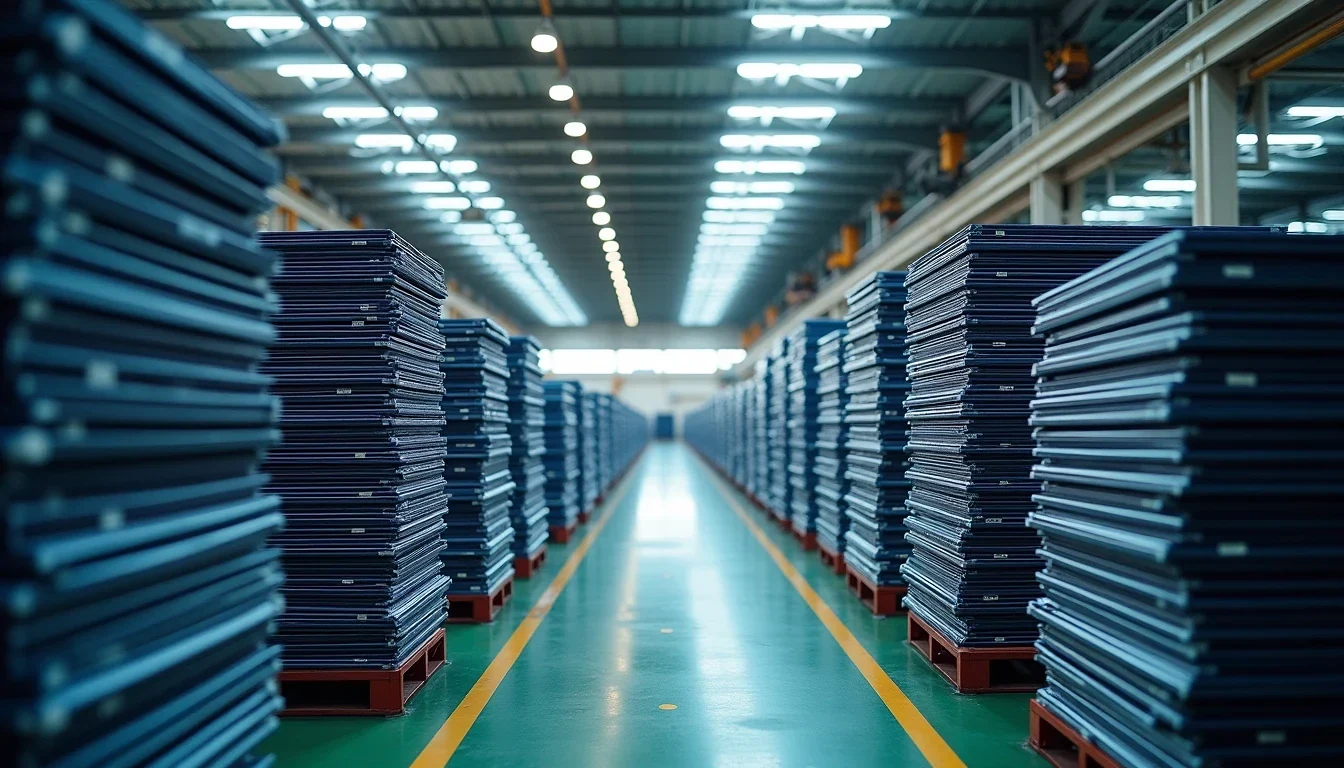
China did not merely grow. It flooded the zone. Global solar module costs fell by more than 90% between 2010 and 2020, according to BloombergNEF. That price crash helped make solar cheap enough to spread everywhere, but it also crushed the manufacturers outside China that could not borrow like a state-backed giant or sell below cost for long enough to kill the competition.
This is the part people keep forgetting because it is politically inconvenient. The Chinese system did not just make solar cheaper. It made solar so cheap that many Western producers could not survive the competition. Solyndra went under in 2011. Q-Cells followed in 2012. Those were not isolated accidents. They were signs that the board had changed and the old players had not noticed in time.
Why tariffs failed
Duties hit the symptom, not the machine
Tariffs are useful when the other side is basically competing on a level field and just needs a little kick in the shins. That was never the case here. China had scale, integrated supply chains and financing that Western firms could not match. It could make polysilicon, turn it into wafers, turn those into cells and modules, then ship them out at prices that made imported protection look decorative.
Even when tariffs bit, Chinese firms worked around them. They shifted the final assembly into Vietnam, Malaysia and Thailand, then sent modules onward under a different passport. That is not a loophole in the poetic sense. It is the industrial equivalent of moving the goalposts into another country.
The deeper problem was that the US and Europe tried to defend an industry without building one. That is not strategy. That is nostalgia with customs paperwork.
The supply chain became one country’s map
By 2023, China’s grip extended across the chain, not just one stage of it. That is the dangerous part. If one country controls the materials, the intermediate products, the cells and the modules, it does not just set prices. It sets the tempo of the global transition.
What leverage Beijing has
The real power is speed, not sabotage
I do not think Beijing wakes up every morning plotting to switch off the world’s solar ambitions. That would be clumsy, and China is rarely clumsy when it can avoid it. The leverage is subtler. It can influence timing, pricing and access. If it wants to prioritise domestic demand, projects elsewhere wait. If it tightens exports of key inputs or manufacturing equipment, the pain lands not in a headline but in delayed procurement and higher costs.
That matters because countries planning power systems do not buy solar panels as a fashion statement. They buy them to meet deadlines, lower bills and keep the lights on. A delay of six months on a utility project is a nuisance. A delay across multiple markets becomes a strategic problem.
There is also the softer power. China can present itself as the supplier of affordable climate hardware to the Global South while binding those buyers into its industrial orbit. That is good business and useful diplomacy. It is also why solar has become part of the same geopolitical game as shipping lanes, gas contracts and chip fabs.
Not every dependency is a crisis
Some vulnerabilities are serious. If a country cannot source critical components, or if coercive trade restrictions can block a national rollout, that is a genuine security issue. The possibility of supply disruption from trade war, geopolitical tension or even an energy crunch inside China belongs in that category too.
Other dependencies are just uncomfortable. Buying cheap modules from China is not the same as handing over control of your grid. It is a vulnerability, yes, but not every foreign input is a hostage. The mistake is to pretend all dependency is fatal, because that leads to expensive fantasies about self-sufficiency that never get built.
The harder question is whether countries are willing to pay for redundancy. Because if they are not, Beijing does not need to threaten anyone. It only needs to keep being the cheapest supplier in the room, which is often enough.