
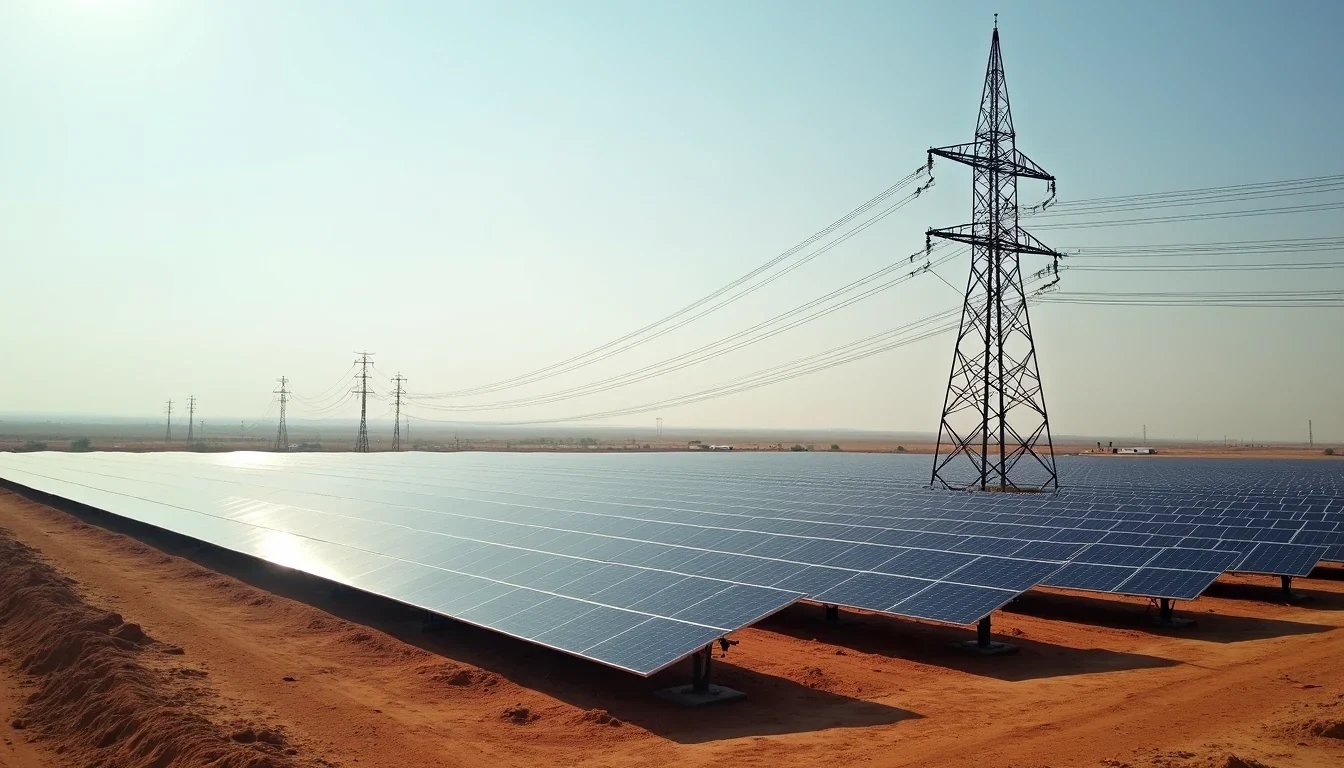
Between April and June 2026, 8,133 gigawatt-hours of solar generation went nowhere. This was not a rounding error or a bad monsoon week. It was roughly the annual consumption of a small European country, thrown away because India’s grid could not move the electrons from where they were made to where they were needed. The panels worked, the sun cooperated, but the wires said no.
When the Hardware Arrives Before the Road
India has been building solar capacity at a pace that would have seemed fantastical a decade ago. Rajasthan and Gujarat in particular have become vast factories of photons, their deserts and scrubland carpeted with modules chasing the country’s 500 GW non-fossil fuel target by 2030. Electrons do not teleport; they need transmission corridors, substations, frequency management, and grid operators with the tools to balance sudden surges and drops. Much of that apparatus is still catching up.
The Power Grid Corporation of India has been laying new lines, including the Green Energy Corridors project launched in 2015 to evacuate 20 GW of renewable power. The problem is sequence: solar projects can clear land, procure modules, and come online in months, but transmission rights-of-way, tower erection, and inter-state coordination take years. The result is a growing archipelago of generation islands, fully operational but poorly connected to the mainland of Indian demand.
During the April-June period, grid security requirements forced operators to curtail output when frequency or voltage stability was at risk. India’s grid was architected for baseload coal plants that run predictably and can be dialled up or down with relative ease. Solar floods in at midday, disappears at dusk, and varies with cloud cover. Managing that rhythm requires forecasting tools, spinning reserves, and fast-ramping resources that the system is only now acquiring. Without them, the safe move is to shut the taps. Nearly 7% of national solar capacity was idled at peak generation moments.
The Geography of Economic Value
It is tempting to treat a gigawatt as a gigawatt, to count installed capacity as progress. The Indian case is a brutal correction. A gigawatt in the Thar Desert with no line to Mumbai or Bangalore is a different asset entirely from a smaller plant outside an industrial zone with flexible demand and existing grid capacity. The first looks good in ministerial speeches, but the second actually displaces fossil fuel and earns revenue.
The 8,133 GWh curtailed in those three months represents capital that was spent, debt that was taken on, land that was occupied, and returns that were promised but not delivered. Developers bear the direct loss. Banks financing projects in congested nodes face repricing. The effective cost of delivered renewable electricity rises because the denominator in any levelized cost calculation shrinks when generation is discarded.
Co-location with storage or demand changes the arithmetic. A solar plant paired with batteries can store midday surplus for evening release, or at least smooth its output enough to stay connected. Industrial loads that can flex their consumption to match generation reduce curtailment risk. These configurations cost more upfront but deliver more usable energy. The market is slowly learning to price that distinction, although India’s auction mechanisms have not always rewarded location or dispatchability over raw capacity.
India’s Problem Is Not Unique
Other countries have walked this path and paid similar tuition. Germany spent €4.2 billion on redispatch measures in 2022, paying northern wind farms to shut down while firing southern gas plants because the transmission lines between them remained unbuilt. California’s CAISO curtailed 2,238 GWh of renewables in 2022, much of it solar caught in the famous “duck curve” of midday oversupply and evening ramp. The state has since mandated batteries at scale, but the waste preceded the fix.
China offers the counterexample of a brute-force solution. Facing severe curtailment in Xinjiang and Gansu in the mid-2010s, Beijing poured investment into ultra-high voltage direct current lines capable of moving gigawatts thousands of kilometres. Curtailment rates fell markedly by 2020. The approach works if you have the capital, the planning authority, and the tolerance for landscape-scale infrastructure. India has the first in growing measure, the second in fragmented form, and the third increasingly tested by project opposition and procedural delay.
Australia’s National Energy Market has seen similar congestion, particularly in South Australia and Queensland. The response there includes the Marinus Link to Tasmania and Project EnergyConnect to New South Wales, using interconnection as a relief valve. The United Kingdom is laying subsea cables like the Eastern Green Link to move Scottish offshore wind south to English demand. In each case, the pattern is identical: generation first, panic second, transmission third.
The Strategic Cost of Paper Capacity
Nations announcing renewable targets without aligned grid investment are not merely inefficient; they are actively misleading themselves. Installed capacity that cannot operate becomes “paper capacity,” a number that satisfies international commitments and domestic headlines while fossil plants keep running to cover the shortfall. India’s 500 GW target will mean less for emissions if a growing fraction of it is routinely curtailed.
The deeper risk is to investment flow. Developers who experience repeated curtailment price that risk into future bids, or exit the market. Foreign capital, which India needs, gravitates toward jurisdictions where the full chain from generation to delivery is credible. A reputation for building solar parks that cannot ship their product is not easily shaken.
There is also a missed industrial opportunity. Countries that solve integration early develop expertise in grid modernisation, storage deployment, and demand-side management that becomes exportable. Those that linger in the generation-only phase become markets for others’ solutions, not originators of their own.
What the Board Looks Like Now
India’s solar industry has effectively split into two games. One is the familiar race to procure land, secure offtake, and install modules ever more cheaply. The other, harder game is securing grid access that converts those panels into usable power. The first game has been played well. The second is still being learned, and the grid is the teacher taking its cut in discarded gigawatt-hours.
The lesson for other nations is structural, not temporal. Solar panels have become the easiest component of the energy transition. Wires, markets, and operating procedures are now the binding constraints. Anyone can announce a gigawatt. The question is whether they can make it arrive anywhere useful.