
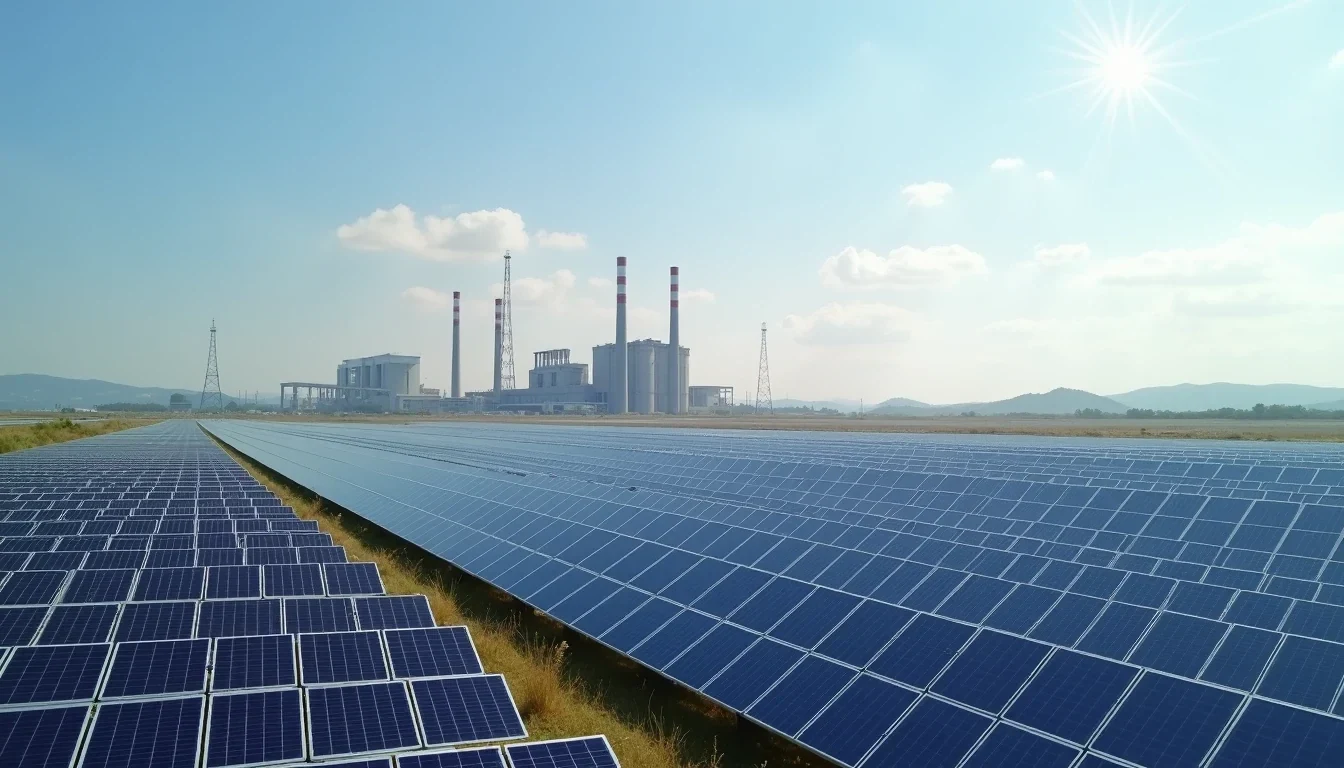
Wind and solar finally achieved what gas advocates spent years insisting could not happen: in April 2026, they surpassed natural gas globally for a full month. Ember’s numbers are blunt enough to annoy the sentimental. Wind and solar supplied 22% of the world’s electricity that month. Gas supplied 20%. Together, wind and solar generated 531 terawatt-hours, a monthly record.
I would not turn that into a victory parade. One month does not rewrite the annual energy mix, and April is a generous month for renewables in many places. However, for those who care about power systems, this is not a curiosity. It is a clean marker of where the market has already moved. Gas is no longer the default answer. It is the one that has to explain itself.
What happened in April
The shape of the result matters as much as the result itself. April sits in the shoulder season for a lot of the world. Heating demand has eased after winter. Air conditioning has not yet taken over. Solar output rises as days lengthen, especially across the Northern Hemisphere, where a large share of global solar capacity sits. Spring wind patterns can also be strong and steady. In some regions, snowmelt lifts hydropower too, which leaves even less room for gas.
I do not read April 2026 as a clean forecast for the whole year. I read it as a stress test that renewables passed more easily than their critics expected. If wind and solar can outproduce gas in a month that is not even the hardest month for electricity demand, then the old story about them being decorative extras has expired.
The deeper point is volume. Five hundred and thirty one terawatt-hours in one month is not a rounding error. It reflects a system that has accumulated enough wind farms and solar parks to matter at global scale, not just in a few rich markets with good marketing departments.
Why gas lost the argument
Gas used to sell itself as the sensible bridge fuel. That story relied on two assumptions. First, renewables would stay too small to compete. Second, gas would keep its role as the flexible backbone of the grid while everyone else dabbled in clean power. April 2026 makes both assumptions look dated.
The cost curve has been doing the damage for years. BloombergNEF’s 2023 work put new utility scale solar PV and onshore wind below new gas-fired generation in most regions. This does not mean every project is cheaper in every place. It means the old reflex—build gas because it is the economical option—is now weak in a lot of markets. When a technology is both cheaper and easier to scale quickly, it stops looking like an alternative and starts looking like the default.
Policy has also changed the game. China has built enormous solar manufacturing capacity. Europe has pushed hard on grid integration and industrial strategy. The United States has used the Inflation Reduction Act to tilt capital toward clean generation and storage. These are not philosophical gestures. They are state-backed attempts to control the next energy order. Gas has been caught on the wrong side of that effort because the system is moving toward an electricity mix shaped by manufacturing, transmission, batteries, and software, not just fuel combustion.
Where gas still has a job
I am not pretending gas is dead. It is not. It still does useful work in plenty of systems, and some of that work is hard to replace.
ERCOT in Texas and the Australian National Electricity Market still lean on gas peakers during tight demand periods. Germany still worries about Dunkelflaute, those long spells of weak wind and low sun. The UK still pays for grid services such as inertia, voltage support, and frequency regulation because synchronous machines are being retired and the grid still needs something to keep its balance. Industrial clusters in Germany and Japan still use gas-fired combined heat and power plants because factories want electricity and process heat, not a lecture.
Gas should now make the point that it earns a specific role where alternatives are still incomplete, rather than deserving a central place by habit. This includes peaking capacity, backup during multi-day low-output events, grid stability, and industrial heat. Perhaps, in some places, it could be a bridge to hydrogen or carbon capture if those ideas ever become more than expensive press releases.
The market language is changing too. Capacity payments, reserve markets, and reliability tenders are increasingly where gas finds its revenue. That is a smaller and more demanding job than being the backbone of the system. The plants that survive will be the ones that solve a narrow problem. Stranded asset risk starts whispering for the ones built on the assumption of high utilization.
What this changes next
The competitive logic has flipped. Wind and solar are no longer trying to prove they belong in the electricity mix. They are the mix, or close enough to force every other technology to defend its space. Gas now has to argue for each hour it runs.
This creates three consequences. First, grid investment matters more than headline generation. Transmission upgrades, storage, demand response, and interconnection are now the battleground because that is how you turn variable supply into a system that can be trusted at 8 p.m. on a cold, still evening. Second, the politics of energy security are changing. Countries with strong solar resources, strong wind regimes, or both can cut imports and strengthen trade balances. Third, the leverage of fossil exporters erodes over time, while the strategic value of copper, lithium, rare earths, and manufacturing capacity rises.
The most revealing part of April 2026 is not that renewables beat gas once. It is that gas is now being judged like a specialist, while wind and solar have become the baseline. This is a brutal reversal for a fuel that spent decades presenting itself as the grown-up in the room.