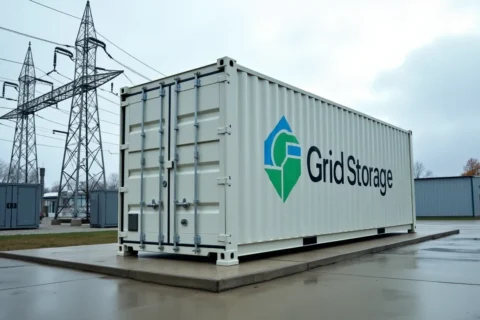

The United States installed 57.6 gigawatt-hours of battery storage in 2025. This figure sounds transformative until you ask how long those batteries actually last. Most discharge for two to four hours. That is enough to shift solar generation into the evening peak or to stabilize grid frequency when a power plant trips offline. It is not enough to keep a hospital running through a four-day ice storm or to maintain water treatment when a cyberattack severs transmission lines across a region. The industry has built an impressive machine for daily energy arbitrage, but not for survival.
The Duration Gap No One Wants to Name
Lithium-ion’s economics falter when you ask for more than a single evening of coverage. The technology scales linearly: double the hours means roughly double the cells and roughly double the cost. A 100-hour lithium-ion system would cost about twenty-five times what a four-hour system of the same power rating costs, according to Department of Energy analysis from 2022. That is not a premium; it is a category error. The battery chemistry that conquered electric vehicles, where weight and volume matter desperately, becomes a financial absurdity when the constraint is simply staying powered through a prolonged disruption.
Grid operators know this. They deploy lithium-ion where it earns its keep: frequency regulation in milliseconds, solar shifting for a few hours, rapid response to price spikes. These are valuable services, but they are also services that end. When the fourth hour passes and the battery is depleted, the outage continues, the temperature drops, and the pumps stop. The 2025 installation record, a genuinely remarkable manufacturing achievement, leaves this gap unaddressed.
The Technologies Waiting in the Hours After Lithium Finishes
A separate market is forming around technologies designed for the moment after short-duration batteries exhaust their charge, when multi-day resilience becomes the only metric that counts. These are not better batteries in the same category. They are different physical systems with different cost structures, often decoupling power capacity from energy capacity so that adding hours of storage does not require proportional increases in expensive components.
Form Energy, backed by Breakthrough Energy Ventures, has developed iron-air batteries that discharge through a rusting and un-rusting cycle using iron, water, and atmospheric oxygen. The materials are abundant enough to make 100-hour duration economically conceivable. Xcel Energy contracted in 2021 for a 15 MW / 1.5 GWh system in Minnesota, targeting deployment by 2025. The power electronics and reaction stacks determine the output; the iron determines the duration. Scaling to longer discharge means adding cheap metal, not multiplying expensive cells.
Flow batteries operate on a similar decoupling principle. ESS Inc., which signed a ten-year supply agreement with Energy Vault in 2023, stores energy in liquid electrolytes pumped through a central stack. Larger tanks mean longer duration without larger stacks. Vanadium redox and zinc-bromine chemistries compete here, each with different material constraints and manufacturing maturity. The category as a whole trades the energy density prized in transportation for cost flatness across time.
Thermal storage takes a different path entirely. Molten salt systems at concentrating solar plants like the Solana Generating Station, operational since 2013 in Arizona, have demonstrated 500°C heat retention for six to fifteen hours. Newer approaches store energy as cold: Highview Power has operated a 5 MW / 15 MWh liquid air plant in the United Kingdom since 2018, using cryogenic temperatures to hold potential energy for release over extended periods. Gravity-based systems from Energy Vault and Gravitricity lift and lower massive weights, with a 35 MWh project under construction in China since 2022. The physical mechanisms vary enormously, but the common feature is duration measured in days, not hours.
Why This Becomes a Market Segmentation, Not a Replacement Story
The strategic logic here is complementarity, not substitution. Long-duration technologies do not need to beat lithium-ion at rapid response. They need to be cheaper than the alternative for hours eight through one hundred: typically fossil fuel peaker plants kept on standby, or the catastrophic cost of widespread outage.
BloombergNEF noted in 2023 that lithium-ion’s cost curve rises steeply with duration, while flow batteries, iron-air, and similar technologies flatten. This creates two distinct procurement decisions. A utility buying four-hour coverage is purchasing a frequency and arbitrage tool. A utility buying hundred-hour coverage is purchasing insurance against systemic failure. The buyers may be the same entity, but the products are not.
The Long Duration Energy Storage Council, formed in 2022, has framed this explicitly: lithium-ion captures the profitable early hours of discharge, while LDES captures the subsequent hours that would otherwise require fuel combustion or load shedding. The IEA’s 2023 World Energy Outlook identified this multi-day firming capability as essential for high renewable penetration. Renewables do not fail daily, but they fail occasionally for extended periods, and those periods determine whether a grid can abandon fossil backup entirely.
The Players Betting on a Different Kind of Storage
Government funding has shaped this field more than market demand so far. The US Department of Energy’s ARPA-E program supported Form Energy’s early development. China’s national energy plans include large-scale LDES pilots now under construction. The European Union channels support through Horizon Europe, treating long-duration storage as infrastructure for 2050 climate neutrality rather than as a near-term revenue opportunity.
Private capital follows public conviction with notable discipline. Breakthrough Energy Ventures, the Gates-founded fund, holds positions in both Form Energy and Ambri, the latter pursuing liquid metal batteries for four-to-ten-hour applications. Temasek and the Canada Pension Plan Investment Board have joined later rounds, suggesting institutional confidence that the technology risk is narrowing even as commercial risk remains substantial.
Utility partnerships provide the critical path to scale. Xcel Energy’s Minnesota project tests whether iron-air can meet promised duration and cost in a real grid environment. Siemens Energy and EDF have explored multiple LDES chemistries without yet committing to dominant standards. The pattern resembles early renewable energy deployment: technology demonstration, policy support, gradual cost reduction, then competitive procurement.
What the Board Looks Like Now
The game here is about who defines the categories. If storage remains a single market measured in gigawatt-hours installed, lithium-ion wins indefinitely on manufacturing scale and learning curve. If duration becomes a segmented market with distinct procurement rules, revenue streams, and reliability requirements, then iron-air, flow batteries, thermal systems, and their competitors each find defended positions.
The 57.6 gigawatt-hours added in 2025 mostly discharge in four hours or less. That is not a failure; it is a successful conquest of one market that leaves adjacent territory unclaimed. The companies building for hundred-hour duration are not betting against lithium-ion. They are betting that grid operators, regulators, and ultimately ratepayers will recognize that daily shifting and multi-day survival are different services, with different values, requiring different machines. The ice storm does not care about the evening peak. Someone will build for what the ice storm actually demands.