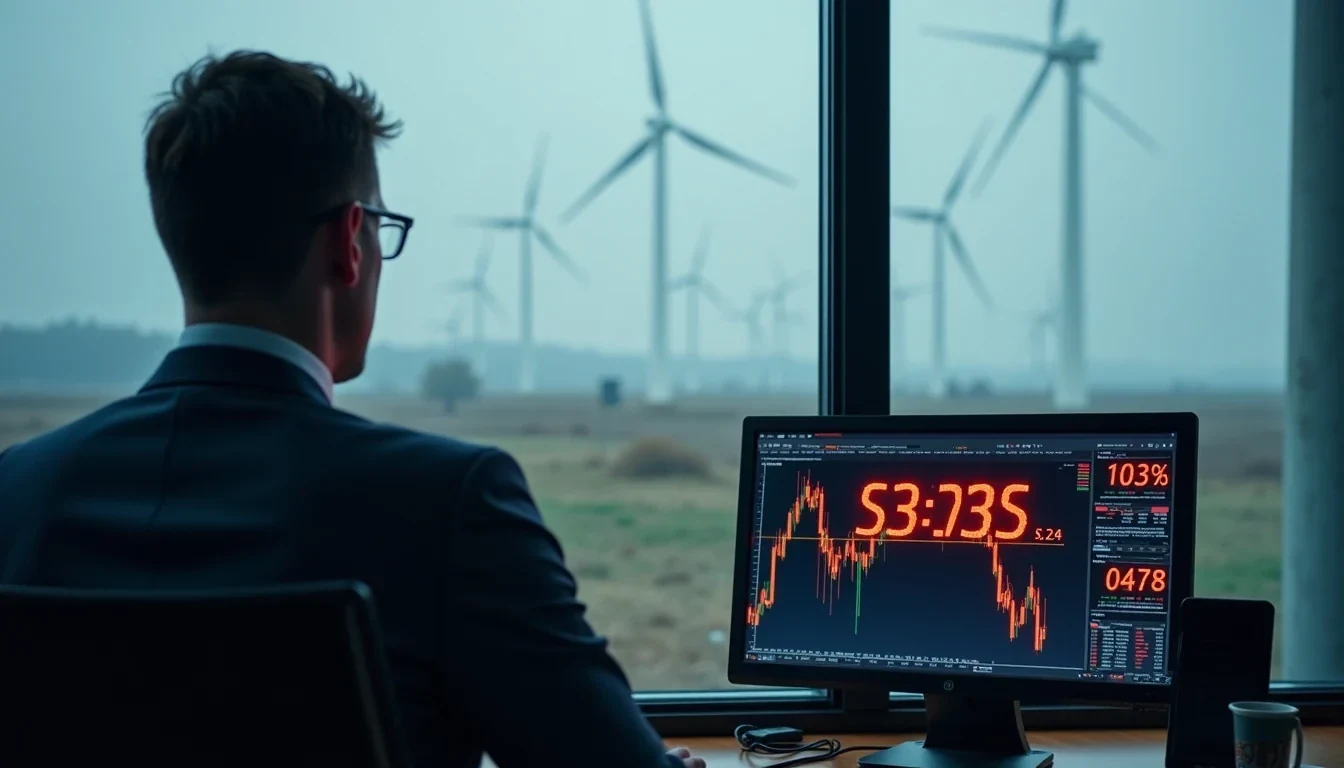
Germany, Spain, and Sweden all crossed 500 hours of negative wholesale power prices in 2025. This is not a scandal. The market is telling us, in the bluntest possible way, that the old value chain no longer works on a simple “more generation equals more value” basis.
Cheap power at midday does not prove solar is broken. It proves the system has a timing problem. If electrons arrive when the grid is already full, the seller has less power than the buyer who can actually use them at that moment. This is where the money is moving.
What happened
Negative prices appear when supply runs ahead of demand and the system has nowhere useful to put the surplus. In practice, that means high wind or strong solar output colliding with low consumption, limited storage, and congested transmission lines. The price can go below zero because someone, somewhere, is effectively being paid to take the electricity away.
Germany had 304 hours of negative prices in 2023, according to Ember. Spain had 109 hours that same year, according to OMIE. By 2025, the scale is larger still: Germany, Spain, and Sweden each passed 500 negative-price hours. This is a recurring feature of grids that are adding cheap variable generation faster than they are adding flexibility.
The obvious mistake is to read those numbers as a verdict on renewables. I think that reading is lazy. It treats the wholesale price as a scorecard for technology, when it is really a scorecard for system design. The problem is not that solar and wind create too much electricity at times. The problem is that the rest of the system has not kept up.
Why generators keep running
If prices are negative, why not switch off? Real power systems are full of awkward incentives.
Many renewable plants are backed by feed-in tariffs or contract-for-difference schemes, so the operator still gets paid even if the spot market is underwater. A generator with a guaranteed tariff does not behave like a merchant trader staring at the screen in a panic. It behaves like a business that already knows where the revenue is coming from.
Conventional plants have their own reasons. Nuclear units, such as Forsmark in Sweden, are built to run steadily. Dropping output and then bringing it back up is slow, expensive, and rough on equipment. Coal and gas plants face the same basic problem. Shutting down and restarting costs money, burns fuel, and chews through maintenance budgets. In some cases the loss from a few negative-price hours is cheaper than the mechanical pain of cycling the plant.
There is also the unglamorous matter of system services. Some units stay online because grid operators need frequency support, voltage control, or other balancing functions that do not show up in a simple energy price. A plant can be losing money on the megawatt-hours while still earning enough elsewhere to make staying online rational. Ugly economics, but honest ones.
Where the value is moving
Negative prices are not the death of value. They are the transfer of value.
For a long time, the prize in electricity was straightforward: produce more megawatt-hours at lower cost. That still matters, but it is no longer the whole game. The better business now is to control timing and location. If you can absorb power when the market is flooded, or hold it and release it later, you have something that plain generation cannot offer.
Battery storage is the cleanest example. A large battery in Germany can charge when the market is effectively paying it to consume power, then discharge later when prices recover. The European Association for Storage of Energy expects 30 GW of battery storage in Europe by 2030, which shows where investors think the leverage is.
Electrolysers for green hydrogen point in the same direction. H2 Green Steel in Sweden has been planning large-scale hydrogen-linked industrial production, and that kind of process becomes far more competitive when it can soak up cheap electricity in the hours nobody else wants it. The same logic applies to chemical plants, water treatment facilities, and data centres that can shift load without shutting down.
Even electric vehicle charging is changing. Smart charging and vehicle-to-grid systems let cars behave less like passive consumers and more like mobile storage. Porsche has been testing vehicle-to-grid in Germany since 2023, a neat sign that even the luxury end of the car market has noticed the grid is becoming a trading floor.
What still limits the game
Flexibility sounds elegant until you run into geography. Electricity is not only a product, it is a local product. A surplus in one part of a country is not useful if the wires to the demand centre are already full.
Cross-border interconnectors matter because of this. Viking Link, which connects the UK and Denmark and became operational in 2023 and 2024, exists for exactly this kind of situation. When one market is drowning in power and another needs it, transmission capacity turns a price problem into a trade opportunity. Without enough of those links, negative prices stay trapped in the region where the surplus was created.
Grid operators know this better than anyone. Svenska kraftnät and its peers are now dealing with a system where forecasting, balancing, and congestion management matter as much as building new generation. The European Commission’s 2023 electricity market reform proposals point in the same direction, because the old market design, which mostly rewards MWh, is too blunt for a grid full of flexible demand and volatile supply.
What it means next
I do not think negative prices are a warning that the energy transition has gone too far. I think they are a warning that the next fight is over flexibility, not output. The winners will be the assets that can move with the market, not the ones that merely add volume to it.
This is the strategic shift hiding inside those hours below zero. The question is no longer only who can make the electricity. It is who can be in the right place, at the right time, with the right appetite to take it.