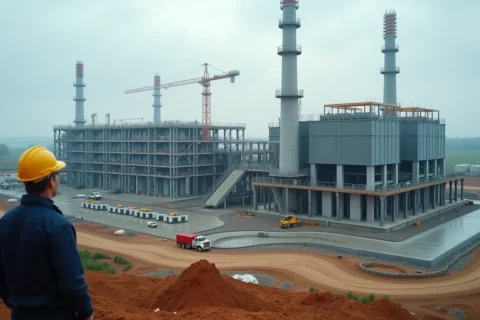

The nuclear industry wants you to look at the reactor: its fuel density, baseload reliability, and zero-carbon profile. The physics were solved in the 1950s. The problem killing projects from Hinkley Point to Vogtle is that nobody wants to lend money for fifteen years against a concrete shell that might crack, a regulator that might stall, and a competitor that might undercut you with solar before you flip the switch.
The figure that should frame every conversation about nuclear’s revival is roughly $250 billion annually. Industry estimates put this as the required global investment to hit the capacity targets governments have announced. This is not a technology gap but a cash-flow architecture problem. A large reactor can accrue interest costs for a decade or more before selling a single megawatt-hour. In that environment, fuel efficiency, safety case, and waste management plan are secondary to one question: who sits on the debt while the concrete cures, and who eats the loss if it cures late?
The Cost Structure Nobody Wants to Discuss
Nuclear fuel is compact. Operating costs, once running, are stable and predictable. However, financing dominates the final price when construction stretches or stumbles. The physics of fission does not change whether a project comes in on budget, but the financing math does. A two-year delay pushes back revenue, compounds the interest burden, inflates the total capital at risk, and can turn a marginal project into an unrecoverable one.
The decisive business model issue is who bears delay risk, not whether the reactor design is Generation III+ or small modular. Private developers, looking at the track record of Flamanville 3 or the Vogtle expansion, price that risk into their cost of capital. The result is a bid that looks uncompetitive against gas, against wind plus batteries, and against anything with a shorter payback horizon. The capital structure fails, not the technology.
How Governments Are Restacking the Deck
Four countries are now experimenting with ways to remove that risk from private balance sheets and place it somewhere else.
The United Kingdom deployed the Regulated Asset Base model for Sizewell C, announced in 2022. Consumers begin paying for the plant through their bills during construction, not after completion. The developer gets an early revenue stream, the cost of capital drops, and the project becomes financeable. The political cost is that households subsidise a plant they may not want years before it produces power. Without this transfer, the plant would not be built at all.
France, never fully comfortable with private ownership of strategic infrastructure, has leaned toward direct state participation and state-backed loans. EDF, renationalised in 2023, carries projects on a balance sheet that the state ultimately guarantees. This model works if you trust the state’s project management. The Flamanville 3 experience, now over a decade late, suggests that cheap capital does not automatically produce competent execution.
Sweden has taken a different angle, with Vattenfall exploring models that blend state ownership with regulated returns designed to attract pension capital. The pitch is nuclear as infrastructure: boring, long-duration, matching liabilities that stretch across decades. Swedish pension funds, like most institutional investors, have alternatives. They can buy German grid assets, Canadian pipelines, or Australian ports. Nuclear must compete for that allocation on risk-adjusted terms, not national sentiment.
The United States, characteristically fragmented, has layered multiple mechanisms. The Inflation Reduction Act of 2022 added production tax credits for existing reactors and investment credits for new ones. The Department of Energy has expanded loan guarantee authority. The US lacks a single coordinating model. Each project, from TerraPower in Wyoming to the various Vogtle follow-ons that may never come, assembles its own financing patchwork. This results in higher transaction costs and greater uncertainty about whether the federal backstop will hold across multiple administrations.
What This Means for the Board
These experiments share a common recognition. Nuclear power is not being held back by public opposition, though that exists. It is not being held back by waste disposal, though that remains unresolved. It is being held back by a mismatch between the asset’s duration and the capital markets’ appetite for duration at a price developers can afford.
The strategic question, then, is not whether nuclear can work. It is whether states are willing to make it work by absorbing risks they have spent forty years trying to offload onto markets. Every model described above involves some form of socialised cost: consumer prepayment in Britain, state balance sheet exposure in France, pension fund guarantees in Sweden, and federal tax expenditure in the United States. The nuclear renaissance, if it comes, will arrive as a public-private partnership in which the public carries the downside and the private captures the operating upside.
This is a defensible choice for a baseload zero-carbon source. It also competes for the same public capital as grid expansion, storage deployment, and demand-side programmes that deploy faster and carry less concentration risk. The governments betting on nuclear are not betting on better physics. They are betting that they can build financial structures patient enough to outlast the concrete. Some will be right. The history of the industry suggests most will not.